
Every fall I pull handfuls of wet leaves, spruce needles and shingle grit out of eavestroughs around Grande Prairie. Most homeowners have no idea how full theirs are until water starts pouring over the side. Plugged gutters are a small problem in October. Come January they can turn into ice dams, icicles the size of your arm and water where you really do not want it.
The short version: clean the leaves and needles out of your eavestroughs and make sure the downspouts run clear before the snow sticks around. It is one of the cheapest things you can do to protect your roof edge, your fascia and the ground by your foundation over the winter.
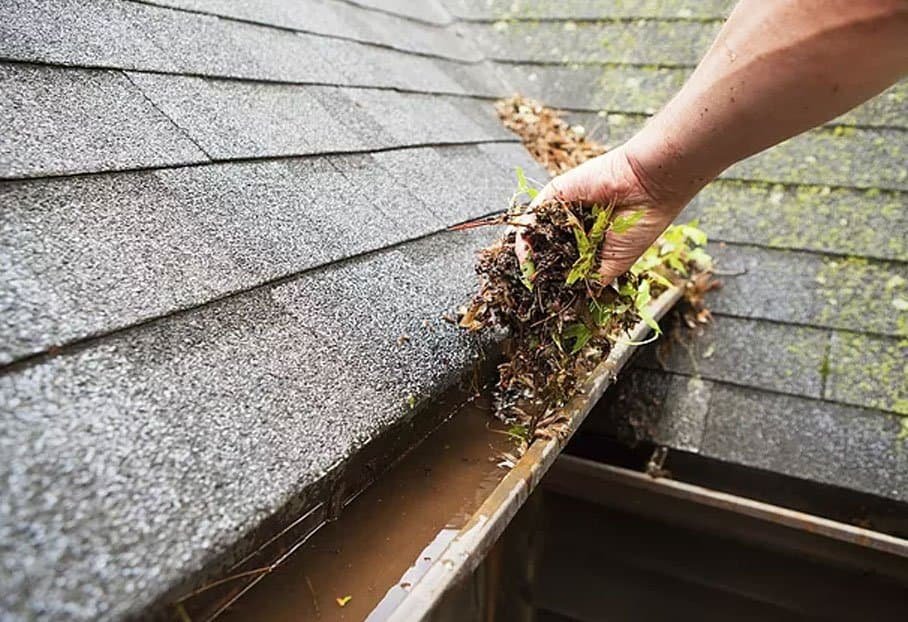
What actually happens in a plugged gutter
A gutter is just a channel. When it is full of leaves, the water from rain or melting snow has nowhere to go. In the fall it spills over the edge. In the winter it sits there and freezes. Now you have a trough full of ice right at the edge of the roof, and every bit of melt that runs down after that has even less room.
How ice dams form
Ice dams come from a simple cycle. Heat from the house warms the upper part of the roof and the snow up there melts a little. That water runs down to the edge, which is colder because it hangs out past the warm part of the house. There it freezes again. Do that over and over through a few freeze and thaw days and you get a ridge of ice along the eaves.
Once that ridge is there, the next round of melt backs up behind it. Water that pools on a roof can work its way under the shingles. A gutter that is already packed with leaves and ice makes the whole thing worse, because the water cannot drain away even on a mild afternoon.
Clean gutters will not stop every ice dam. Attic insulation and roof ventilation play a big part too, and that is a job for a roofer or an insulation company. But a clear gutter and downspout gives the melt a way off the roof, and that helps a lot.
Signs your eavestroughs need attention
- Water spilling over the front during a fall rain instead of going down the downspout.
- Plants or moss growing in the gutter. If something is growing in there, it is full.
- Gutters pulling away from the fascia or sagging between brackets. Wet leaves and ice are heavy.
- Stains or peeling paint on the fascia or siding right below the gutter.
- A puddle or soft ground by the foundation where a downspout should be draining.
When to do it
The best time is after most of the leaves are down but before the snow stays for good. In Grande Prairie that window is usually October, and it can close fast. If you have a lot of spruce or pine around the house, needles drop all year, so it is worth a look in spring too.
Doing it yourself
If you are comfortable on a ladder, it is a doable job. Use a sturdy ladder on solid, level ground, have someone hold it, and never lean out past the rails. Scoop the debris out by hand or with a gutter scoop, then run a hose through to make sure the downspout drains. If water backs up, the downspout is plugged too. A wet October roof is slippery, so if the shingles are frosty or wet, wait for a better day. If heights are not your thing, that is a good reason to hire it out.
Common questions
How often should gutters be cleaned in Grande Prairie?
At least once a year in the fall. Homes with a lot of trees close by often need a spring cleaning too.
Can I clean gutters once there is snow on the roof?
It gets a lot harder and less safe. Try to get it done before the snow stays.
Will clean gutters stop ice dams?
They help the melt drain away, but insulation and ventilation in the attic matter too. If you get big ice dams every year, have a roofer take a look.
Do you clean gutters?
Yes. Gutter cleaning is one of our fall add ons. We clean the leaves and needles out by hand.
Get your gutters cleaned before the freeze
Gutter cleaning pairs well with a fall yard cleanup, since we are already there clearing the leaves. If your lawn still has leaves on it too, read our post on fall leaf cleanup. Our fall season runs until October 31 or until the weather shuts it down, so ask for a gutter cleaning quote or call or text Drew at 587 818 5838.


